Are Love Calculators Accurate?
Are love calculators accurate? No — the same two names score 55% on one site and 78% on another, and a 15-second test exposes any calculator.
Yazan Kunal Bansal ·
Love calculators are not accurate, and no honest one claims otherwise. What separates them is whether the number is repeatable and whether the method is published, which is a much lower bar than accuracy and one most of them still fail.
This page runs that test in public, including on our own love calculator by name.
The honest answer
Nothing that reads letters can measure a relationship. Spelling carries no information about trust, timing or kindness, so a percentage built from letters is arithmetic wearing the language of insight.
We build one of these tools. Saying so plainly costs nothing, because the value of a love calculator was never prediction — it is a two-name game with a number at the end.
Consistent is not the same as accurate
Consistent means the same two names always return the same score. Accurate would mean the score corresponds to something real about two people. The first is achievable and testable. The second is not available to any tool that reads only names.
Our calculator returns 55% for Rahul and Priya. It returns 55% on the next reload, on another device, and in the reverse order. That is consistency, and it is the entire claim.
| Check | Result |
|---|---|
| Same names, three runs | 55% · 55% · 55% |
| Reversed order | 55% |
| Extra spaces and capitals | 55% |
The same two names, two different websites
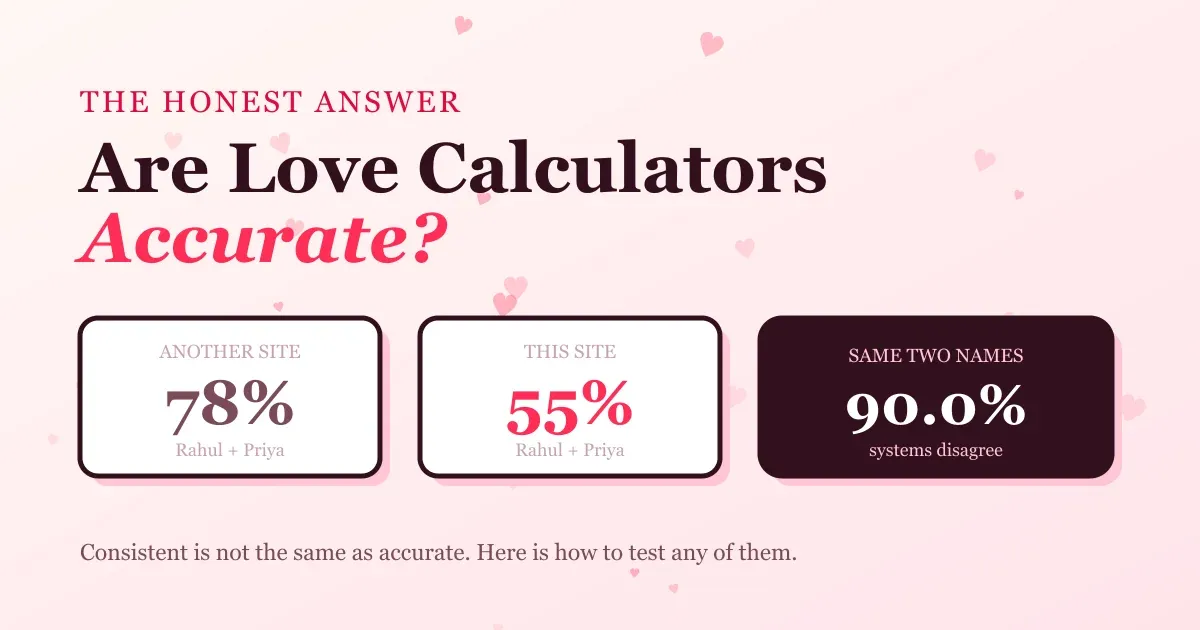
A published guide on another calculator gives Rahul + Priya → 78%. Our engine gives 55% for that identical pair.
78%
another site's result
Rahul + Priya
55%
our result
Rahul + Priya
90.0%
of the time systems disagree
measured across four scoring methods
Neither number is right, because there is no right answer to be close to. Both are what a particular arithmetic returned. Run four different scoring systems over the same set of names and they disagree on which band a pair belongs in 90.0% of the time.
How to test any love calculator in 15 seconds
To test a calculator, run the same two names through it three times and watch whether the number moves. No technical knowledge is needed, and the whole check fits in a quarter of a minute.
-
Score a pair, then reload
Enter two names and note the number. Reload the page and enter the same two names. A tool that re-rolls is generating random numbers.
-
Swap the order
Enter the names the other way round. A different result means the tool never sorted the inputs, so who types first changes the answer.
-
Add a space
Type one name with a trailing space. A changed score means the input was never tidied before the arithmetic ran.
A calculator that passes all three is consistent. That still says nothing about accuracy — it only means the tool is doing arithmetic rather than rolling dice.
One letter, 46 points
Changing a single letter in one name moves our score by 46 points, which is the clearest evidence available that these tools measure spelling rather than people.
| Pair | Score | Band |
|---|---|---|
| Rahul + Aysha | 81% | Deeply Devoted |
| Rahul + Ayesha | 76% | A Beautiful Match |
| Rahul + Aisha | 35% | Opposites Attract |
The same person can be Aysha on one form and Aisha on another. Any quantity that swings 46 points on an orthographic choice is not tracking a relationship.
The reason is visible once you run the arithmetic yourself. Swapping one letter changes the letter counts the whole method is built on, and our guide to calculating love percentage by hand shows that fold step by step.
Why the number feels right anyway
The number feels right because general statements read as personal when you are the one reading them. Psychologists have measured this repeatedly, and the effects are well named.
- The Forer effect. Bertram Forer gave students an identical personality description and asked each to rate how well it fitted. They rated it highly, believing it was written for them individually.
- Processing fluency. Simon Laham’s work found that names which are easier to pronounce are judged more positively, so how a pairing reads affects how the result lands before any number appears.
- Confirmation bias. A high score gets treated as evidence, and a low score gets treated as a fluke — which is the same reasoning applied in two directions.
- Implicit egotism. Brett Pelham reported that people gravitate toward things resembling their own names. Uri Simonsohn later challenged the size of that effect, and the disagreement is worth knowing about if the idea gets cited at you as settled.
Names do carry real-world consequences, which is a separate and much better-evidenced finding. Marianne Bertrand and Sendhil Mullainathan sent matched résumés differing only by name and measured a gap in callback rates. That is about hiring discrimination, not compatibility, and no love calculator has any bearing on it.
What actually predicts a relationship
Nothing on this page does. The factors with genuine research behind them — how a couple handles conflict, whether they repair after arguments, shared expectations about money and family — are not derivable from two names, and no arrangement of letters gets you closer to them.
That is the honest limit of the format, and it applies equally to every calculator you will find.
Are love calculators safe to use?
Ours never transmits what you type, because the arithmetic runs inside your browser and no server takes part in it. Close the tab and nothing remains.
Whether a love calculator is safe depends on the site, so the questions worth asking are the same three every time: does it ask you to sign up, does it ask for anything beyond two names, and does it need a server round-trip to return a score. A calculator that wants an email address for a letter-counting game is collecting an email address, not calculating anything.
Love calculator privacy comes down to that last point. If the score can be produced without contacting a server, there is nothing to store and nothing to leak.
The love calculator virus worry that circulates is mostly misplaced for the tools themselves. The real risk on this kind of site is advertising, not arithmetic. Our privacy policy sets out what we do and do not collect.
So is any love calculator real?
Both answers are true depending on which word you mean. Real in the sense that the arithmetic exists, is published and repeats exactly. Fake in the sense people usually intend, because it predicts nothing.
Our score distribution is measured rather than asserted: 90%-plus results appear in 1.8% of pairs, and the median score across 1,600 pairings is 61%. Those figures exist because the same formula runs every time. A tool returning random numbers has no distribution to publish, which is why almost none of them do.
Try the calculator you just read about
Two names, one score, and the full method published on the page. Run it twice to check the number holds.
Open the love calculatorFrequently asked questions
Are love calculators accurate?
No. A love calculator reads the letters in two names and returns a number. Letters carry no information about trust, timing or kindness, so no result predicts anything about a relationship.
Is the love calculator real or fake?
Both, depending on the word. The arithmetic is real, published in full and repeats exactly. The prediction is fake, because nothing derived from spelling can forecast a relationship.
Which is the most accurate love calculator?
None of them is accurate. The most trustworthy is the one that publishes its method and returns the same score for the same two names every time, which you can verify yourself in about fifteen seconds.
Why do two websites give different results for the same names?
Because each site runs a different formula. Measured across four scoring methods, systems disagree about which band a pair falls into 90.0% of the time.
Is a love calculator safe to use?
Ours is, because the calculation runs in your browser and nothing you type is transmitted or stored. Safety varies elsewhere, so avoid any calculator that asks for an email address or anything beyond two names.
Does a low score mean anything?
No. A low score means the letters in the two names have little in common. Scores below 40% occur for 15.3% of pairs, and the figure carries no information about the people involved.
Is love calculator accurate for predicting a relationship?
No. Asking is the love calculator accurate is really asking whether spelling predicts behaviour, and it does not. The arithmetic is repeatable, which is a different property and the only one any of these tools can honestly claim.
Is a love calculator fake?
The prediction is. Whether a love calculator is real or fake depends on which half you mean: the formula genuinely exists and repeats, while the compatibility claim on top of it has nothing behind it. A tool that re-rolls its number on reload is fake in both senses at once.